
Patient and Caregiver Perceptions of Facilitators and Barriers to Engagement
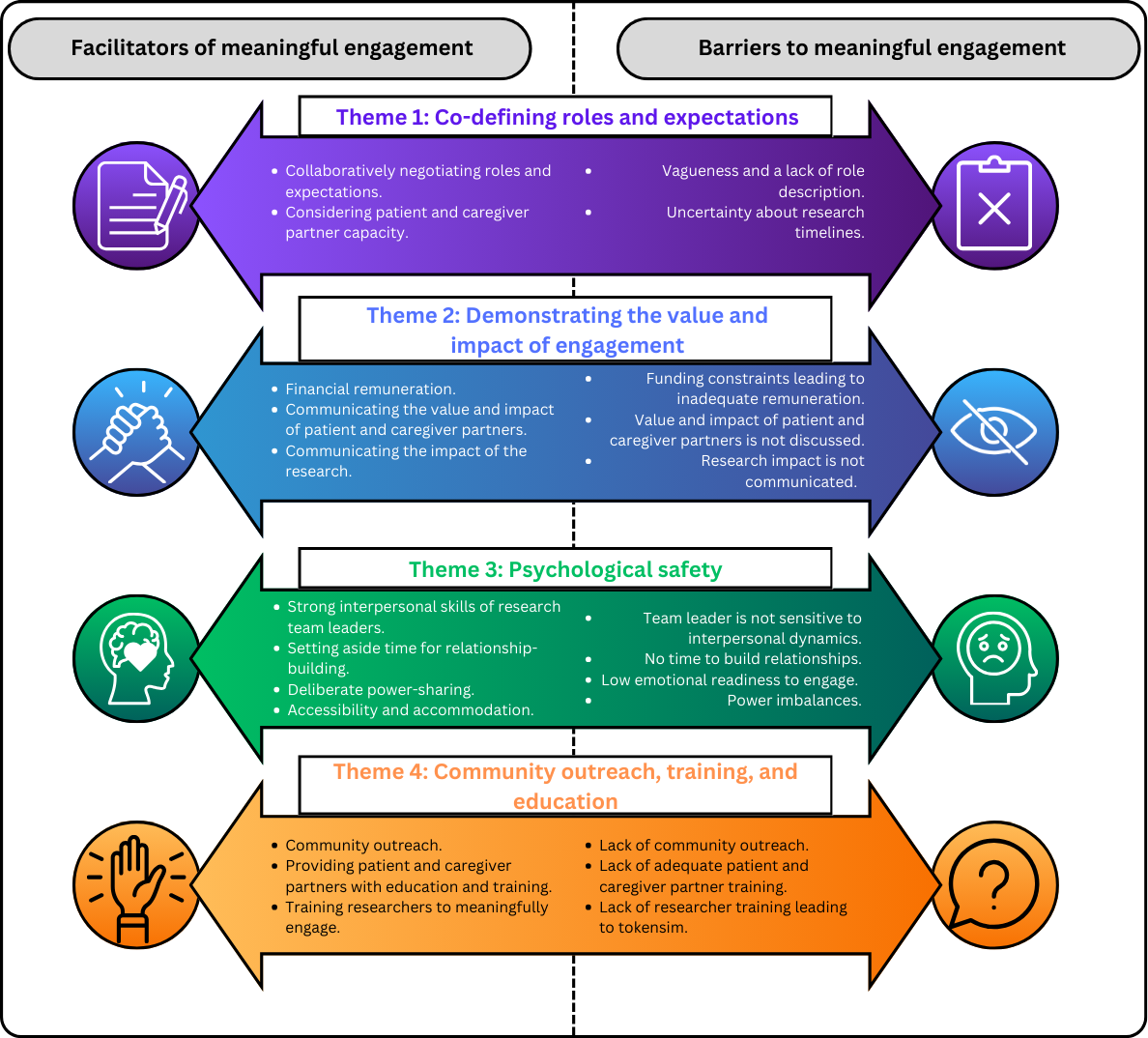
Article full title: Exploring Patient and Caregiver Perceptions of the Facilitators and Barriers to Patient Engagement in Research: Participatory Qualitative Study
Study aims: To better understand what helps patients and caregivers feel meaningfully engaged as partners in health research, and what gets in the way of this meaningful engagement.
What we did: A patient partner and researcher jointly interviewed 13 patients and caregivers from across Canada about their experiences partnering on health research projects. After the interviews were completed, a separate group of 8 patient and caregiver partners worked alongside the research team to help review and interpret the interview findings. Together, they identified the most important ideas and patterns that emerged from the interviews. This helped ensure that the study findings truly reflected patient and caregiver partner perspectives and experiences around what supports meaningful engagement and what makes it more difficult.
What we found: Meaningful engagement was strongest when patients and caregivers understood their role, felt respected and psychologically safe, and could see that their input was genuinely shaping the research. Support, training, and clear communication were also identified as important for creating positive research partnerships. When these things were missing, patients and caregivers often felt overlooked, uncertain about their role, or included only “for show” rather than as true partners. The study also provides practical recommendations to help researchers build more meaningful and respectful partnerships with patients and caregivers.

Teaching Patient Engagement in Research
Article full title: Higher education curricula and approaches to patient engagement in research: A case study
Study aims: To explore how patient engagement in research can be taught within university or college courses, and how this education can better prepare students, patients, and caregivers to work together as research partners.
What we did: This paper describes a graduate university course focused on teaching patient engagement in research. Patients, caregivers, students, and educators who were also researchers worked together to help shape what was taught and how it was taught. The goal was to create training that helps people better understand how to work together respectfully and meaningfully in research partnerships.
What we found: A university course focused on patient engagement helped strengthen students’ understanding of how to engage patients and caregivers as partners in research and how to conduct research that reflects patient and caregiver priorities and perspectives. The course also supported more meaningful collaboration between students, researchers, patients, and caregivers. In addition, the study showed that involving patients and caregivers in shaping course content and teaching approaches can improve how patient engagement is taught and help build the skills and attitudes needed for true partnership-based research.