

Activities and Impacts of Patient Engagement
Article full title: Activities and impacts of patient engagement in CIHR SPOR funded research: a cross-sectional survey of academic researcher and patient partner experiences
Study aims: To describe engagement activities and perceived impacts of projects funded by the Strategy for Patient-Oriented Research (SPOR).
What we did: We surveyed 66 academic researchers and 20 patient partners who were involved in research projects across 13 SPOR funding calls (2014–2019). Thematic analysis was used to describe engagement activities and impacts.
What we found: Patient partners were engaged in seven types of activities across the research cycle: (a) sharing experiences/giving advice, (b) identifying the research focus/methods, (c) developing/revising aspects of the project, (d) conducting research activities, (e) study participation, (f ) presenting on behalf of the project, and (g) other grant development or knowledge translation activities. Engagement was associated with six different types of impacts related to knowledge, outputs, or directions being (a) created, (b) moulded, (c) confirmed, or (d) chosen/prioritized, (e) perceived success of the research, and (f) minimal/negative impacts on the research.

Participatory Member Checking
Article full title: Participatory member checking: A novel approach for engaging participants in co-creating qualitative findings
Key concepts: Member checking is a process where research participants are invited to review and provide feedback on researchers’ early interpretations of interview or focus group findings to help ensure the results accurately reflect their experiences and perspectives.
Study aims: This study developed and tested a new approach called Participatory Member Checking, designed to involve research participants more actively in the member checking process.
What we did: This study was part of a larger research project that involved patient partners who had previously participated in interviews about their experiences with patient engagement in research. After the research team completed an initial analysis of the interviews, participants were invited to take part in a Participatory Member Checking process developed as part of this study. Participants reviewed draft themes and supporting quotes from the interviews, shared written feedback, and took part in group and individual discussions to help clarify, refine, and strengthen the findings. The research team then used this feedback to revise the analysis. Participants were also shown how their feedback was incorporated into the final findings.
What we found: Participatory Member Checking led to important improvements in the research findings. Through this process, participants’ feedback helped identify ideas that had been missed, clarify and strengthen key themes, and ensure the findings more accurately reflected participants’ real experiences and perspectives. The process also brought forward additional insights and details that were not fully captured in the research team’s initial analysis. Overall, participants were highly engaged in the Participatory Member Checking process, and their involvement helped strengthen the quality and accuracy of the final findings.
CALM Hearts Engagement and Optimization
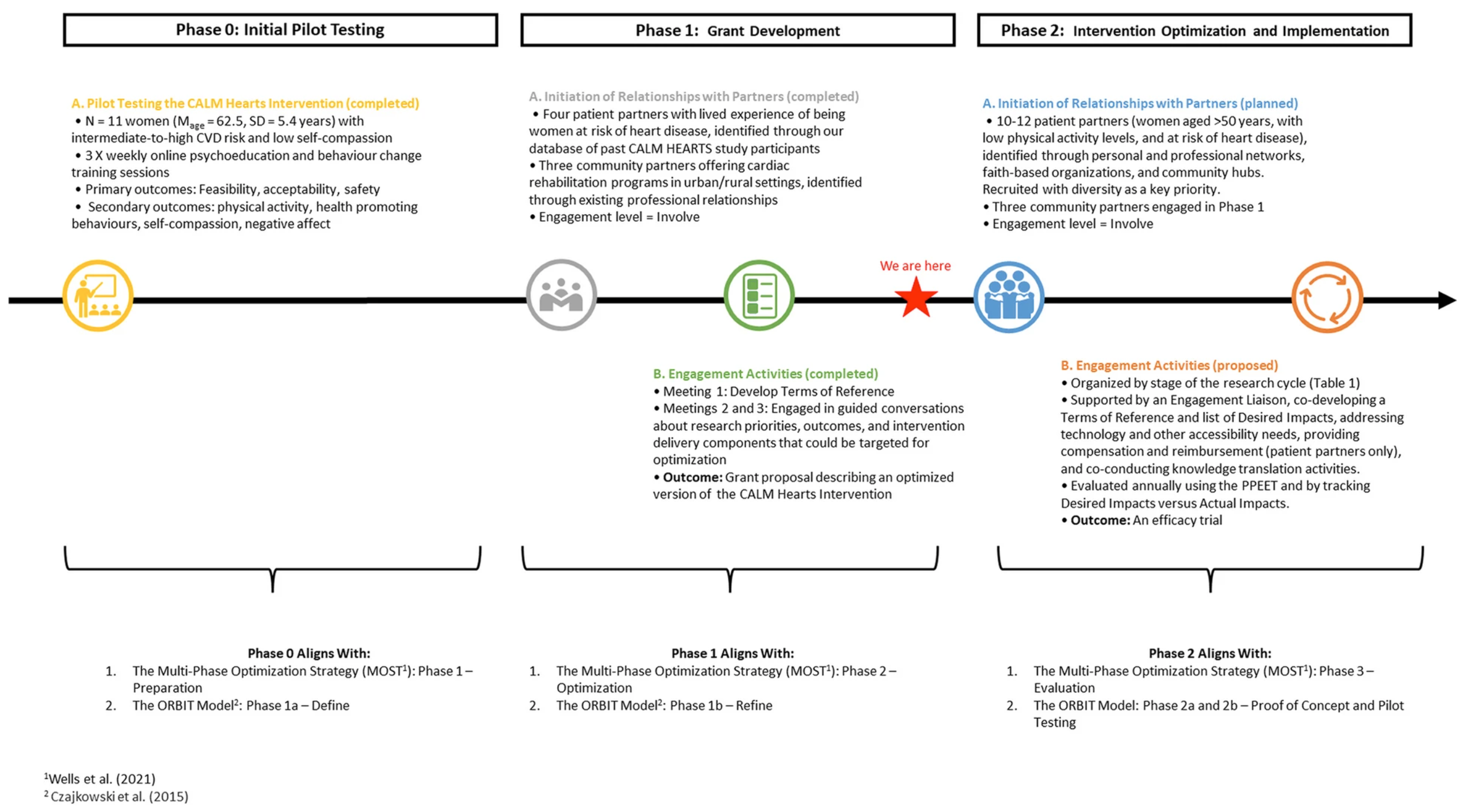
Article full title: Engaging patient and community stakeholders in the optimization of the Compassionate And Loving Mindset towards heart health risk (CALM Hearts) physical activity intervention: a description of initial work and protocol for future engagement activities
Key concepts:
CALM Hearts: A physical activity programme for women at risk of heart disease that teaches self-compassion as a way to support health behaviour change.
Patient and community engagement: Partnering with patients, caregivers, and community organizations on research projects, so their perspectives help shape research decisions and directions.
Optimization: Improving an existing program before testing how well it works and preparing it for real-world delivery.
Study aims: This paper had two aims. First, it describes how patient and community partners helped shape a grant proposal to improve the CALM Hearts programme. Second, it presents a plan for how patient and community partners will continue to be engaged as CALM Hearts is improved, tested, and prepared for future delivery in community settings.
What we did: CALM Hearts had already been developed and tested with a small group of participants. In this study, we worked with four patient partners and three community partners to identify what should be improved before the programme is tested in a larger study and prepared for delivery in community settings. Patient and community partners helped establish shared expectations for working together, identify priority areas for improvement, and co-develop a detailed engagement plan for future stages of the project. Uniquely, the paper also presents and explains this engagement plan to help other researchers think through how to meaningfully engage patients and community partners when improving health programmes for real-world use.
What we found: Patient and community partners helped identify several ways to improve CALM Hearts, including delivering the programme in small groups, adding a follow-up booster session, and involving community staff in future training and delivery. The study shows how engaging patients and community organizations can help make an existing health programme more practical, relevant, and ready for future testing and community use.

Engaging and Care Partners in Data Analysis and Synthesis
Article full title: A virtual, multi-session workshop model for integrating patient and public perspectives in research analysis and interpretation
Study aims: To provide a virtual workshop model for integrating patient and public stakeholder perspectives in data analysis and interpretation.
What we did: Our model involves four virtual workshop sessions held on separate days, each achieving the unique goals of (a) establishing participants’ technological literacy within the virtual platform, (b) obtaining responses to the research question, (c) introducing participant perspectives into research analysis and interpretation, and (d) prioritizing research findings or future research agendas.
What we found: This paper contributes toward a toolkit for patient engagement in research. Our model could be applied in research areas where there is currently minimal patient engagement. We also provide a practical approach to engaging with patients virtually, with a specific discussion of equity, diversity, and inclusion.
Arts-Based Methods in Research
Article full title: The use of arts‐based methods to enhance patient engagement in health research
Key concept:
Arts-based methods: Research approaches that use artistic activities — such as storytelling, photography, drawing, visual arts, or performance — to help people express and communicate their experiences in different ways.
Study aims: To better understand how creative and arts-based activities are being used in patient engagement in research, and how these approaches may help patients and care partners share their experiences and perspectives.
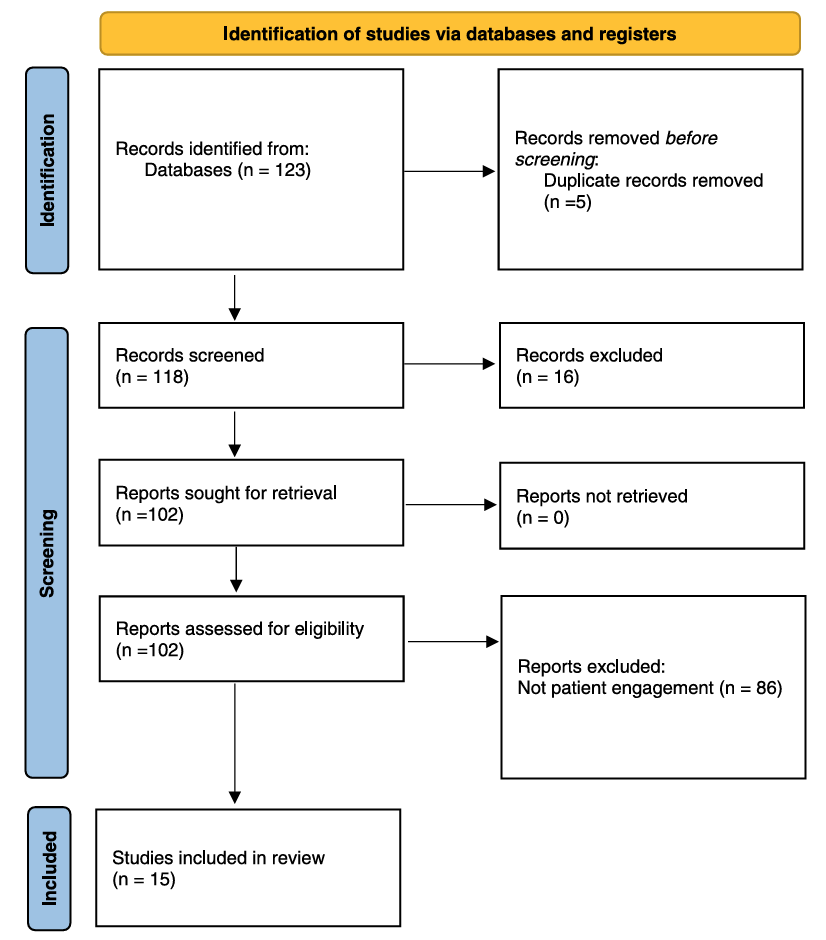
What we did: We conducted a review of published research studies that used arts-based methods to engage patients and caregivers as partners in research. We searched multiple academic databases to identify relevant studies and examined how different arts-based approaches were used in research settings. In total, 15 studies were included in the review.
What we found: The studies used many different arts-based methods and often combined multiple creative approaches. Overall, these methods appeared to support patient engagement by giving participants more flexible and meaningful ways to share their lived experiences than traditional research methods alone. Arts-based methods also helped people communicate complex or emotional experiences and support deeper engagement in the research process. However, studies often described their methods and findings differently, making it difficult to compare results across studies.